

Agora Discourse and the Principle Uganda Needs Most: Justice Beyond Tribe, Politics, and Personal Histories
In a political climate where loyalty often determines who deserves empathy, protection, or due process, Agora’s stance represents something rare in Uganda today: principled, impartial advocacy.
Agora Discourse and the Principle Uganda Needs Most: Justice Beyond Tribe, Politics, and Personal Histories
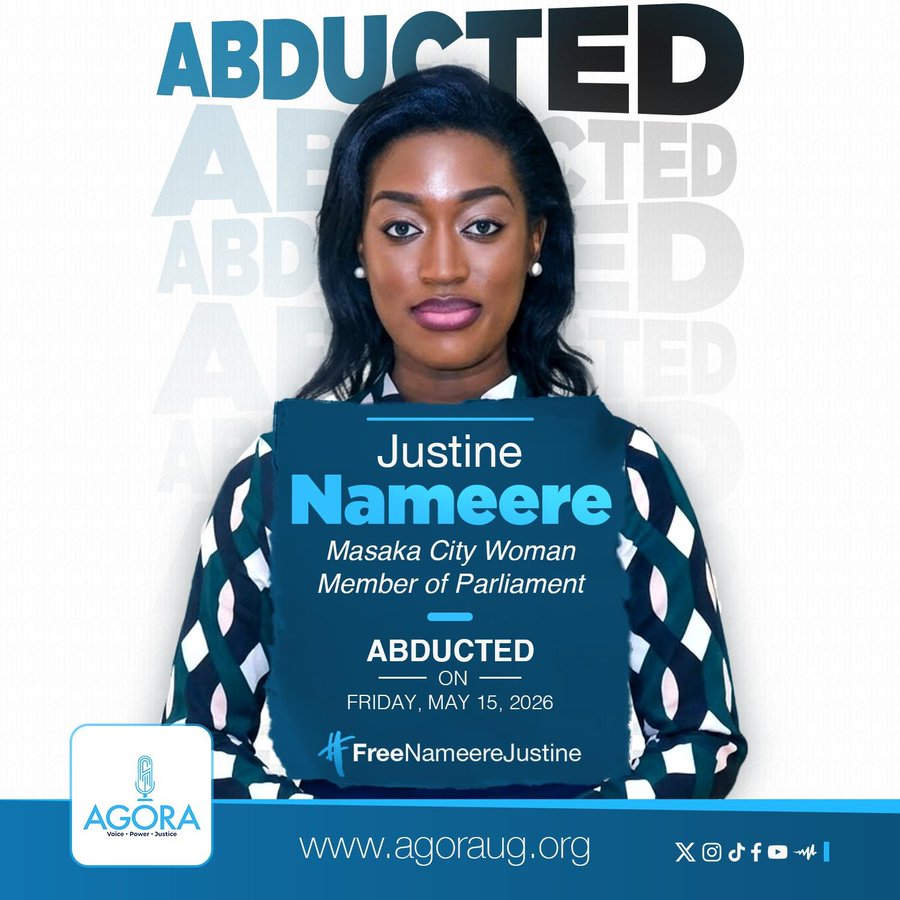
The recent decision by Agora Discourse to defend Nameere’s rights, despite her long‑standing alignment with Uganda’s ruling establishment, has sparked important national reflection. In a political climate where loyalty often determines who deserves empathy, protection, or due process, Agora’s stance represents something rare in Uganda today: principled, impartial advocacy.
Their message is simple but radical:
Justice is not a reward for good behavior, nor a privilege reserved for political allies. It is a right owed to every citizen even those whose opinions you strongly oppose.
Justice That Depends on Identity Is Not Justice
Uganda’s political environment has conditioned many citizens to view fairness through the lenses of:
tribe
political party
religious affiliation
class
personal loyalty
This has created a culture where it seems almost natural to ignore the suffering of someone who “belongs to the other side.” In Nameere’s case, many Ugandans feel she openly defended state abuse and mocked its victims. For some, it feels poetic that she now faces the machinery she once justified.
But Agora’s position reminds us why that thinking is dangerous.
The rule of law collapses the moment we decide that some people are not worthy of it.
Why Defending Her Rights Still Matters
It would have been easy even emotionally satisfying for Agora to stay silent. Yet they are insisting that:
detention must be lawful
due process must be followed
no individual deserves regime basements, torture, or disappearance
principles must not shift depending on who is suffering
This is the core of genuine social justice: standing for rights even when the victim is someone who once stood against you.
It is a test of integrity, not affection.
A Warning to NRM Supporters: Power Does Not Protect Forever
There is also a critical lesson for supporters of the ruling NRM:
When the regime embraces you, it’s easy to feel untouchable. But when it discards you and eventually it discards everyone only the people you once insulted will remain to defend your rights.
Uganda’s political history is full of examples of former insiders suddenly becoming enemies of the state overnight. Those who once cheered repression often find themselves relying on the very activists, lawyers, and citizens they dismissed.
Agora’s stance highlights this broader truth:
No one should rely on power structures to protect their dignity. Only a culture of equal justice can do that.
Building a Uganda Where Justice Is Not Selective
What Agora Discourse is modeling is the civic ethic Uganda desperately needs:
Advocate for rights universally.
Stand against abuse no matter who suffers it.
Refuse the temptation of revenge justice.
Defend the humanity of opponents.
This is not softness. It is the foundation of a lawful, stable society.
If Uganda adopted this mindset, if citizens defended principles rather than personalities the country would move closer to the rule of law, genuine accountability, and a political culture that protects everyone rather than a privileged few.
The Bigger Picture
By defending Nameere’s rights, Agora is defending the rights of all Ugandans, including those who don’t yet realize they will need those protections someday. Their message is a challenge to the nation:
Stand for justice even when it’s inconvenient.
Stand for rights even when it’s someone you dislike.
Stand for the rule of law because one day, it may be all that stands for you.
ByAdmin
Admin account author